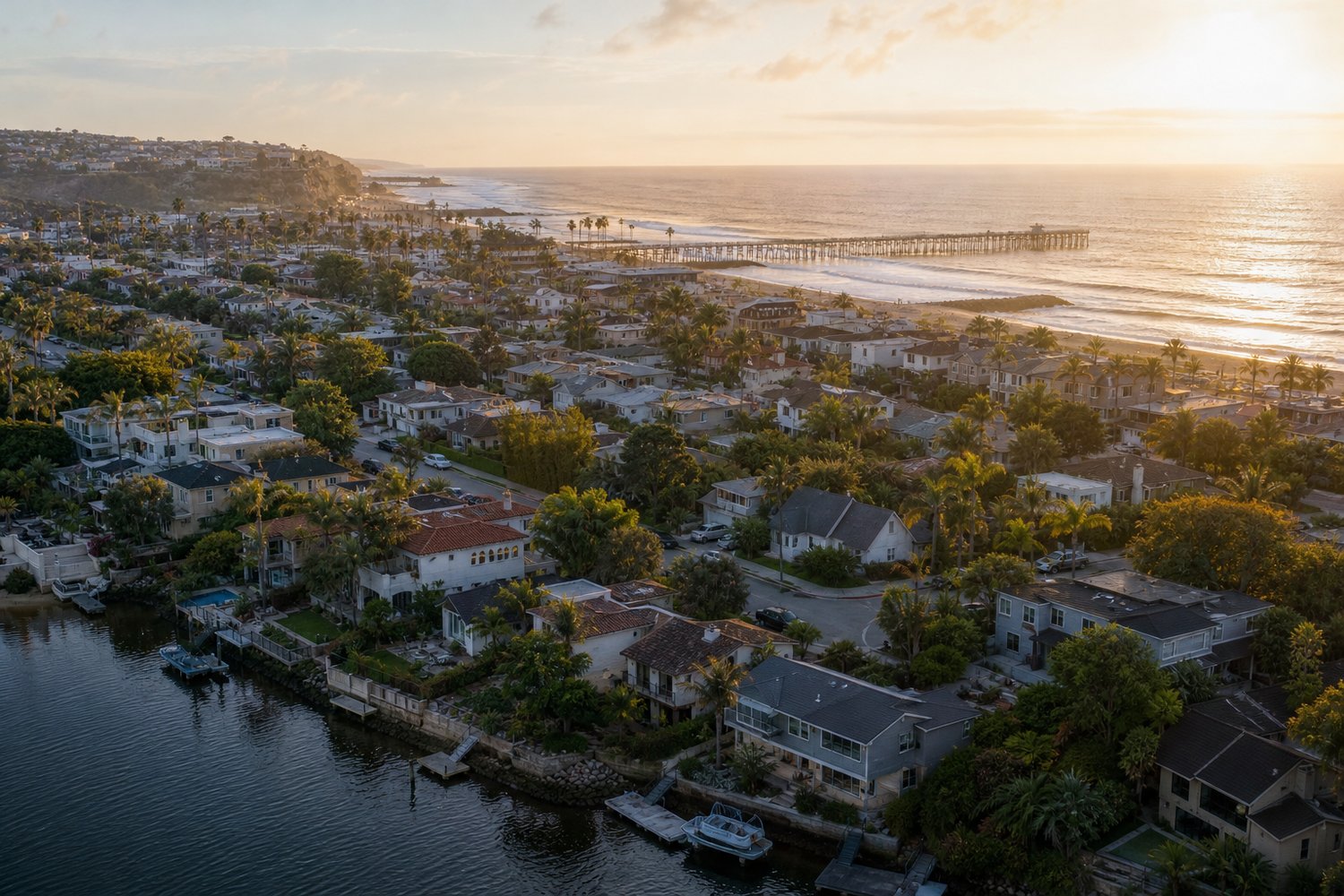
Redevelopment can lift demand for nearby homes over time, but no verified data puts a number on it yet. Your result depends on how close you are to work zones, your home’s condition, and when you list. A local pricing review beats any headline estimate.
Does downtown redevelopment raise home values in Oceanside?
The way redevelopment affects property values in downtown Oceanside comes down to distance, timing, and condition. Adopted planning policy and multiyear infrastructure work are well documented, but no verified source puts a percentage or dollar premium on downtown-area homes. Expect short-term construction friction for properties beside work zones, and a longer-term case built on upgraded utilities, new housing, a new hotel, and nearby amenities.
Key Takeaways
- Across the wider Oceanside, CA market, the median sale price was $860,000 for homes sold in the trailing 90 days through October 2026, an area-wide figure that says nothing about what any one home is worth.
- In that same window, 427 homes sold, 364 homes were on the market, and 148 new listings arrived in the last 30 days, so a seller near downtown competes with a steady flow of inventory.
- Oceanside adopted its Onward Oceanside planning framework on June 24, 2026, but adopted policy is not the same as finished construction or a proven price increase.
- Phase II of the downtown water and sewer replacement began in March 2026 and is expected to run about two years, so the active construction period stretches into early 2028.
- No verified, current source quantifies how much downtown redevelopment has raised or will raise individual property values, which makes a street-by-street pricing review essential.
What is actually being built and planned in downtown Oceanside?
Downtown Oceanside has an adopted planning framework, a multiyear utility replacement program, and new mixed-use and hotel activity in the pipeline. Those are three different things, and sellers get into trouble when they blur them together.
The planning framework
On June 24, 2026, the City adopted Onward Oceanside, which followed more than six years of planning and community engagement. The package includes Phase 2 of the General Plan Update, the Smart and Sustainable Corridors Specific Plan, an updated Climate Action Plan, and related greenhouse-gas significance thresholds.
These policies can shape development capacity, corridor design, mobility, and sustainability standards. They do not, by themselves, establish a measurable increase in property values. Individual projects still need project-level approvals, financing, construction, and occupancy before buyers can walk through them.
The infrastructure work
The City reported that Phase II of the downtown water and sewer replacement began in March 2026 and is expected to continue for approximately two years. The City’s water utilities project page describes a multiyear program touching the Cleveland/Tremont alley, Coast/Tremont Alley, Freeman/Coast Alley, Coast Highway, Pier View Way, Nevada/Ditmar Alley, the Strand, and Breakwater Way. Later phases were scheduled to begin after Labor Day 2026, so check the City’s page for the current schedule near your address.
Beyond utilities, the redevelopment story includes additional housing, a new hotel, and mixed-use activity, plus the State Route 76 gateway area. I’ve covered the resort side in more detail in my post on Oceanside beach resort redevelopment and home values, and the broader seller picture in Oceanside Downtown Revival: What Sellers Need to Know.
How redevelopment affects property values during construction and after
In the short term, construction can make life harder for homes closest to the work. Over the long term, upgraded infrastructure and new amenities give buyers more reasons to want to be nearby. The size of either effect is not verified, so treat both as location-specific possibilities rather than guarantees.
Short term, 2026 to early 2028
While the utility work is underway, properties immediately adjacent to work zones may deal with access changes, noise, parking limits, rough street conditions, and harder showing logistics. A buyer touring your home notices all of that.
Here’s what I tell sellers: plan for it, don’t hide from it. Show up with a clear explanation of the project, the schedule, and what the street will look like when it’s done. A buyer who understands the timeline negotiates very differently from one who finds a trench on the way in.
Long term, after the work is done
Several documented changes could shape how buyers weigh a downtown-area home later:
- Upgraded water and sewer infrastructure in a core area where aging systems were being replaced.
- Additional housing and mixed-use activity, which can bring more dining, services, and foot traffic.
- A new hotel and the visitor activity that comes with it.
- Corridor planning under the Smart and Sustainable Corridors Specific Plan.
- Proximity to downtown amenities for homes within reach of the core.
These are plausible demand drivers. They are not proof of a price increase that has already happened. If anyone hands you a confident percentage, ask for the source. I walked through the investor angle in Oceanside Downtown Resorts Reshaping Buyer and Investor Opportunities.
What the market data does and doesn’t tell you
Recent local market data shows that across the wider Oceanside, CA market, homes sold in the trailing 90 days through October 2026 had a median sale price of $860,000. During that window, 427 homes sold, 364 homes were on the market, and 148 new listings came on in the last 30 days.
That is area-wide context, not a price expectation for your home. A downtown-adjacent property, a coastal home, and an inland home in the same city can sit in very different value ranges. For a sense of how Oceanside compares with other North County markets, here are area-level medians for the same period:
| Area | Median Sale Price |
|---|---|
| Oceanside | $860,000 |
| Encinitas | $2,200,500 |
| Carlsbad | $1,506,000 |
| Del Mar | $3,620,000 |
| Escondido | $890,000 |
| Fallbrook | $928,500 |
| Solana Beach | $1,950,000 |
These are medians for each area as a whole. They don’t isolate downtown Oceanside, and they can’t tell you how redevelopment affects property values on your street. The North San Diego County Association of REALTORS® market statistics are a good place to check regional trends, but regional data can’t prove that downtown work alone moved any price. That’s a limit worth respecting.
What should Oceanside sellers do about timing and pricing?
Decide based on your specific property, not on a headline about redevelopment. Whether to list before the work wraps up or wait depends on how close you are to active work zones, your home’s condition, and your own timeline.
Questions I walk my clients through
- How close are you to an active work zone? Check the City’s project page for your block, since phases and schedules shift.
- What’s the condition of your home? Condition and updates often move price more than a project a few blocks away.
- What’s your timeline? If you need to sell on a set schedule, waiting for the long-term story may not fit your plans.
- What are comparable homes actually doing? Recent closed sales near you tell you more than a projection.
In my 25-plus years working North County, the sellers who do best start at a number buyers will accept rather than cutting their way toward one. That matters even more when buyers are weighing construction against future upside. I cover the pricing side in how to price your Carlsbad, Encinitas, or Oceanside home right in the 2026 seller’s market, and the broader value drivers in what drives Oceanside coastal property values in 2026.
Your specific number depends on your home’s condition, location, and timing. That’s where a local market analysis comes in, and it’s exactly the kind of question I work through with sellers before we ever list.
If you’d like to see what past clients say about working with me, you can read my reviews on Google and Zillow.
FAQ
Will Oceanside downtown redevelopment increase my home’s value?
It may support buyer demand over time, but no verified source quantifies how much it has raised or will raise individual home values. The documented projects, including infrastructure upgrades, new housing, and a new hotel, are plausible demand drivers. Your home’s value still depends on its condition, location, and timing, so a local pricing review is the reliable way to find out.
Will construction near downtown hurt my home’s value in the short term?
It can affect homes immediately adjacent to work zones, but the size and duration of any price effect isn’t verified. Access, noise, parking, and showing convenience are the practical concerns during the work period, which runs from March 2026 into early 2028 for the water and sewer program. Homes farther from the work typically feel less of it.
When will the downtown water and sewer construction be finished?
Phase II began in March 2026 and is expected to continue for approximately two years, which points to early 2028. Later phases were scheduled to begin after Labor Day 2026. Schedules change, so confirm the latest timing on the City’s water utilities project page.
Which Oceanside areas are most affected by downtown projects?
The City’s materials point to the downtown core, Coast Highway, Pier View Way, the Strand, Breakwater Way, and the State Route 76 gateway. Properties closest to those corridors are the ones most likely to notice construction effects first. Confirm how a specific address relates to the work before you decide on timing.
Should I sell before construction is finished or wait for redevelopment to progress?
Neither choice is automatically better, because it depends on your property’s proximity to work zones, its condition, and your timeline. Waiting adds uncertainty since the long-term price effect isn’t verified, while selling during construction means addressing buyer concerns head-on. I’m happy to run the comparison for your home.
The takeaway is simple: redevelopment gives downtown Oceanside real momentum, but your outcome rides on your block, your home, and your timing. If you’re weighing a sale, I’ll give you an honest read on how this plays out for your property. Get a free home valuation and let’s talk through your options.
Equal Housing Opportunity. Matthew Sorensen, Broker Associate, regulated by the California Department of Real Estate. This article is general information, not legal, tax, or financial advice; confirm your own numbers with your escrow officer, tax advisor, or lender.
- About Matt Sorensen
- Contact Matt

Matt Sorensen is a Broker Associate with Coldwell Banker Realty and a licensed real estate professional since 2000, serving San Marcos and North County San Diego. He specializes in probate and trust home sales, helping trustees and families navigate pricing, disclosures, timelines, and vendor coordination with clear communication and steady guidance. CA DRE Lic. #01293787