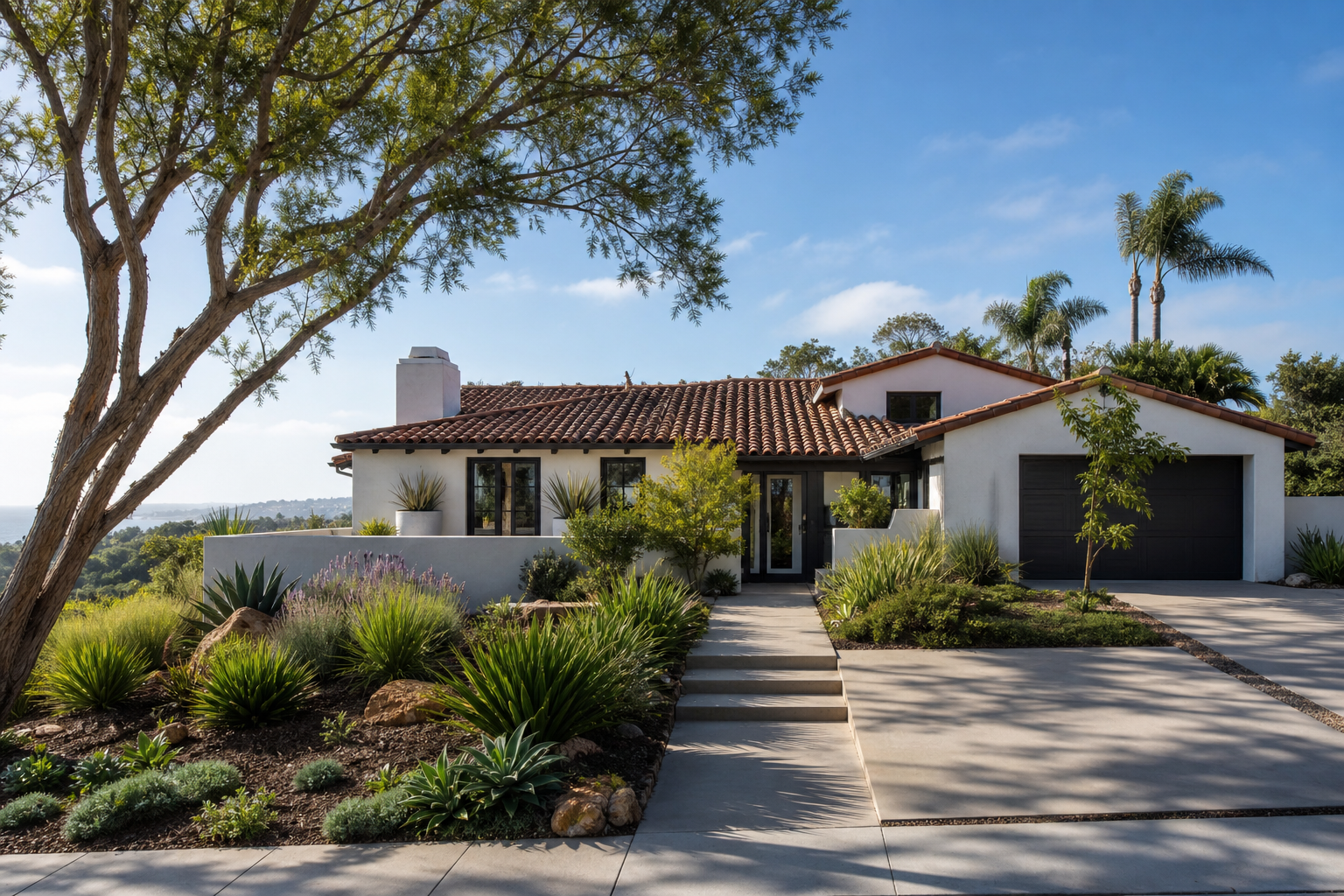
Encinitas coastal homes are selling close to their original list prices in 2026, with a sale-to-list ratio near 98.7%. Overpricing by even 5-10% shifts a home from a fast, full-price sale to a drawn-out price-reduction cycle. Getting the number right on day one is the single most important decision a coastal seller makes.
Pricing Encinitas Coastal Homes Right From Day One
How should I price my Encinitas coastal home to sell quickly and for top dollar?
In 2026, Encinitas coastal homes are selling very close to their original list prices, the year-to-date sale-to-list ratio through July 2026 is approximately 98.7%, according to San Diego Association of REALTORS® ZIP-level data for 92024. That means the market rewards accurate pricing and punishes overpricing with extended days on market and repeated reductions. The sellers who net the most are the ones who price correctly from the start, not the ones who test the ceiling and chase the market down.
Key Takeaways
- The year-to-date median sale price for detached homes in Encinitas (ZIP 92024) rose from approximately $2,128,500 to $2,400,000 through July 2026, a 12.8% increase year-over-year, per SDAR data.
- Encinitas homes sold in a median of 21 days over the three months ending July 2026, down from 27 days a year earlier, but only for correctly priced listings.
- The sale-to-list ratio in 92024 reached approximately 98.7% year-to-date through July 2026, meaning buyers are not negotiating large discounts off list, they are simply passing on overpriced homes.
- West of I-5 commands a meaningful premium over east-of-I-5 Encinitas neighborhoods, and that gap must be reflected in the list price, not discovered after weeks of silence.
- Homes that sit 45 to 60-plus days before receiving an offer still face a full escrow period on top of that, compounding carrying costs and signaling distress to subsequent buyers.
Why does Encinitas coastal pricing punish overpricing more than other markets?
The short answer: buyers here are sophisticated, well-represented, and have options. They are not going to fall in love with a number that doesn’t match the data.
According to Redfin’s Encinitas market data, the median sale price over the three months ending July 2026 was approximately $2.2 million, up 14.4% year-over-year, with transaction volume also rising, 158 homes sold in July 2026 versus 144 in July 2025. That’s a genuinely strong market. But strong markets don’t protect overpriced listings. They just make the contrast more obvious.
Here’s the dynamic I see play out repeatedly: a seller prices 8 to 10% above where the data points, expecting to negotiate down. Buyers see the DOM climbing. By week three, the listing starts to feel stale. A price reduction brings a fresh wave of attention, but now those buyers wonder what’s wrong with the property. The seller ends up netting less than they would have with an accurate day-one price, and they’ve added weeks (sometimes months) to their timeline.
The SDAR data for ZIP 92024 makes this concrete: a 98.7% sale-to-list ratio means buyers aren’t negotiating sellers down from inflated prices, they’re simply moving on. The homes that sell are the ones priced where the market actually is.
For a deeper look at how I approach this across North County, see my post on pricing your Encinitas home correctly.
What the area comparison tells you
Encinitas sits in a distinct tier among North County coastal markets. Here’s how recent local market data compares across the region (trailing approximately 90 days, as of September 2026):
| Area | Median Sale Price | Median Days on Market |
|---|---|---|
| Encinitas | $2,050,000 | 60 |
| Carlsbad | $1,329,300 | 32 |
| Del Mar | $3,825,000 | 51 |
| Escondido | $865,000 | 28 |
| Fallbrook | $900,000 | 41 |
| Oceanside | $890,000 | 17 |
| Solana Beach | $2,132,500 | 47 |
Notice that Encinitas carries a longer median days on market than most of its neighbors. That’s not a sign of a weak market, it reflects the complexity and price sensitivity of coastal luxury product. Buyers at the $2 million-plus level are deliberate. They compare across Encinitas, Solana Beach, and Del Mar. An overpriced listing doesn’t just sit; it actively educates buyers that competing properties are better value.
What actually drives pricing differences within Encinitas coastal neighborhoods?
This is where national data tools, Zestimates, automated valuations, county assessor records, fall apart. They can’t see the things that move the needle most on a coastal property.
West of I-5 versus east of I-5
This is the single biggest pricing variable in Encinitas, and it’s not subtle. West-of-I-5 properties, whether in Leucadia, Old Encinitas, or the coastal bluff areas, carry a premium that reflects walkability to the beach, proximity to Highway 101, and the lifestyle that buyers in this price range are explicitly paying for. East-of-I-5 neighborhoods like Village Park and New Encinitas offer excellent value and strong schools, but they serve a different buyer and a different price point.
Pricing a west-of-I-5 home using east-of-I-5 comps, or vice versa, is one of the most common mistakes I see in this market. The freeway is a genuine pricing boundary, and any comparative market analysis that blurs it will produce a number you can’t defend to a serious buyer.
View corridors, lot orientation, and micro-location
In Cardiff-by-the-Sea and along the Leucadia bluffs, small differences in elevation, lot orientation, and power-line placement can shift perceived value significantly. A home with a clear ocean view from the living room and primary bedroom commands a premium that a home two streets back with a partial view does not, even if they’re the same square footage and build year. Cardiff’s steep topography makes this especially pronounced; the view corridor from one property can be completely blocked by a neighbor’s roofline or a utility pole.
Pricing these premiums correctly requires pulling comps that actually match the view situation, not just the neighborhood and square footage. That’s a judgment call that takes local knowledge, not an algorithm.
Condition and design relative to the price tier
At the $2 million-plus level, buyers expect a certain standard of finish. A dated kitchen or original 1980s bathrooms in a home listed at $2.3 million will generate showings but not offers, buyers will either pass or come in well below list. The correct response is to price the condition accurately from the start, not to list at a renovated-comparable price and hope someone falls in love.
Conversely, a thoughtfully remodeled Leucadia bungalow with modern finishes, an ADU, and a short walk to Moonlight Beach can legitimately push past the area median, but only if the pricing is anchored to actual closed sales of comparable updated product, not wishful thinking about what the seller invested in the renovation.
ADU and redevelopment value in Old Encinitas
Zoning in the Old Encinitas coastal zone creates embedded value that automated tools miss entirely. Lots that support an accessory dwelling unit, or that carry redevelopment potential under California’s ADU laws, are worth more to a specific buyer segment. That value has to be priced in explicitly, with documentation ready, not assumed.
The escrow and disclosure factor
In California, residential transactions close through a neutral escrow officer who coordinates title work, document delivery, and fund disbursement. For coastal properties, that process can include HOA document delivery for townhome and condo product, easement review, and any bluff-stability or permit documentation that’s material to the property. Sellers who have these materials organized before listing reduce the renegotiation risk during escrow, which indirectly protects the original list price by giving buyers less to push back on.
I always walk my sellers through what documentation they’ll need before we set a price, because surprises in escrow are one of the most common reasons a deal renegotiates downward after the fact.
If you want to understand what questions to ask a listing agent before you hire one, my post on what listing agents should prove before you hire them covers exactly that.
Broker compensation in any transaction is fully negotiable and not set by law. There is no standard or customary rate, the listing fee is agreed between you and your agent in the listing agreement, and any compensation offered to a buyer’s agent is a separate, optional decision.
If you’re thinking about listing in Encinitas, I’d genuinely encourage you to read reviews from clients I’ve worked with on Google and Zillow before we talk.
Frequently Asked Questions
How do I price my Encinitas coastal home so I don’t end up chasing the market down with repeated price cuts?
Start with a comparative market analysis built from closed sales of genuinely comparable properties, same side of I-5, similar view situation, similar condition and finish level, from the past 90 days. The SDAR data for ZIP 92024 shows a sale-to-list ratio of approximately 98.7% through July 2026, which means the market is not rewarding inflated list prices with negotiated-down deals; it’s simply bypassing overpriced homes. A data-driven day-one price, even if it feels conservative, consistently outperforms an aspirational price that requires reductions to find a buyer.
How long are properly priced coastal homes in Encinitas taking to sell in 2026, and what happens if I overprice?
According to Redfin’s market data, the median days on market for Encinitas over the three months ending July 2026 was 21 days, down from 27 days a year earlier, for homes that were priced correctly. Overpriced homes often sit 45 to 60-plus days before receiving an offer, then still have to complete a full escrow period on top of that, compounding carrying costs and creating a stigma that makes subsequent buyers wonder what’s wrong with the property.
Are buyers still paying close to asking price for Encinitas coastal properties, or do I need to leave room for big negotiations?
Buyers are paying very close to list for accurately priced homes. The SDAR data for 92024 shows a year-to-date sale-to-list ratio of approximately 98.7% through July 2026. That does not mean you should pad your price expecting to negotiate, it means buyers who see an overpriced listing simply move on rather than making a low offer, so the negotiation room you built in just becomes days on market.
How much does being west of I-5 versus east of I-5 really affect what I can list my Encinitas home for?
The I-5 corridor is a genuine pricing boundary in Encinitas, not a minor variable. West-of-I-5 properties carry a premium tied to beach proximity, walkability to Highway 101, and the coastal lifestyle that buyers at this price point are specifically seeking. The gap varies by street, condition, and view, but it is substantial enough that pricing a west-of-I-5 home using east-of-I-5 comps, or vice versa, will produce a number you can’t defend to a serious buyer. Any accurate CMA must separate these two sub-markets.
What local market stats should I look at when deciding on a list price in Encinitas?
Start with SDAR’s ZIP-level data for 92024, which tracks median sale price, days on market, and sale-to-list ratio on a year-to-date basis, those three numbers together tell you how fast the market is moving and how much pricing discipline buyers are enforcing. Supplement that with Redfin’s Encinitas market page for recent transaction volume trends. Neither source replaces a hand-pulled CMA from your agent using actual closed sales that match your property’s specific location, view, and condition, but they give you a baseline to evaluate what your agent is telling you.
If the Encinitas market is still strong, why do some coastal homes sit for 60-plus days without selling?
Almost always, the answer is price. Recent local market data shows the area median days on market at 60 days across all active and recently sold inventory, but that average includes homes that priced correctly and sold in three weeks alongside homes that overpriced and sat for months. At the $2 million-plus level, the buyer pool is smaller and more deliberate; a home that doesn’t match its price relative to comparable sold properties simply waits. Strong market conditions lift all boats, but they don’t override the fundamental rule that buyers compare everything available to them and choose the best value.
The bottom line: in a market where homes are selling at 98.7% of original list price and the median sale price for detached homes in 92024 has reached approximately $2.4 million year-to-date through July 2026, getting your number right on day one is the highest-leverage decision you’ll make as a seller. I’ve spent more than 25 years pricing homes in this market, and I know the difference between a number that attracts offers and one that generates showings without results.
If you’re thinking about listing your Encinitas coastal property, start with a free home valuation, I’ll pull the actual comps, walk you through the sub-market variables, and give you a defensible number before you make any decisions.
Equal Housing Opportunity. Matthew Sorensen is a Broker Associate licensed by the California Department of Real Estate. This article is general market information only and does not constitute legal, tax, or financial advice. Confirm your specific costs and transaction details with your escrow officer, tax advisor, or lender.
- About Matt Sorensen
- Contact Matt

Matt Sorensen is a Broker Associate with Coldwell Banker Realty and a licensed real estate professional since 2000, serving San Marcos and North County San Diego. He specializes in probate and trust home sales, helping trustees and families navigate pricing, disclosures, timelines, and vendor coordination with clear communication and steady guidance. CA DRE Lic. #01293787