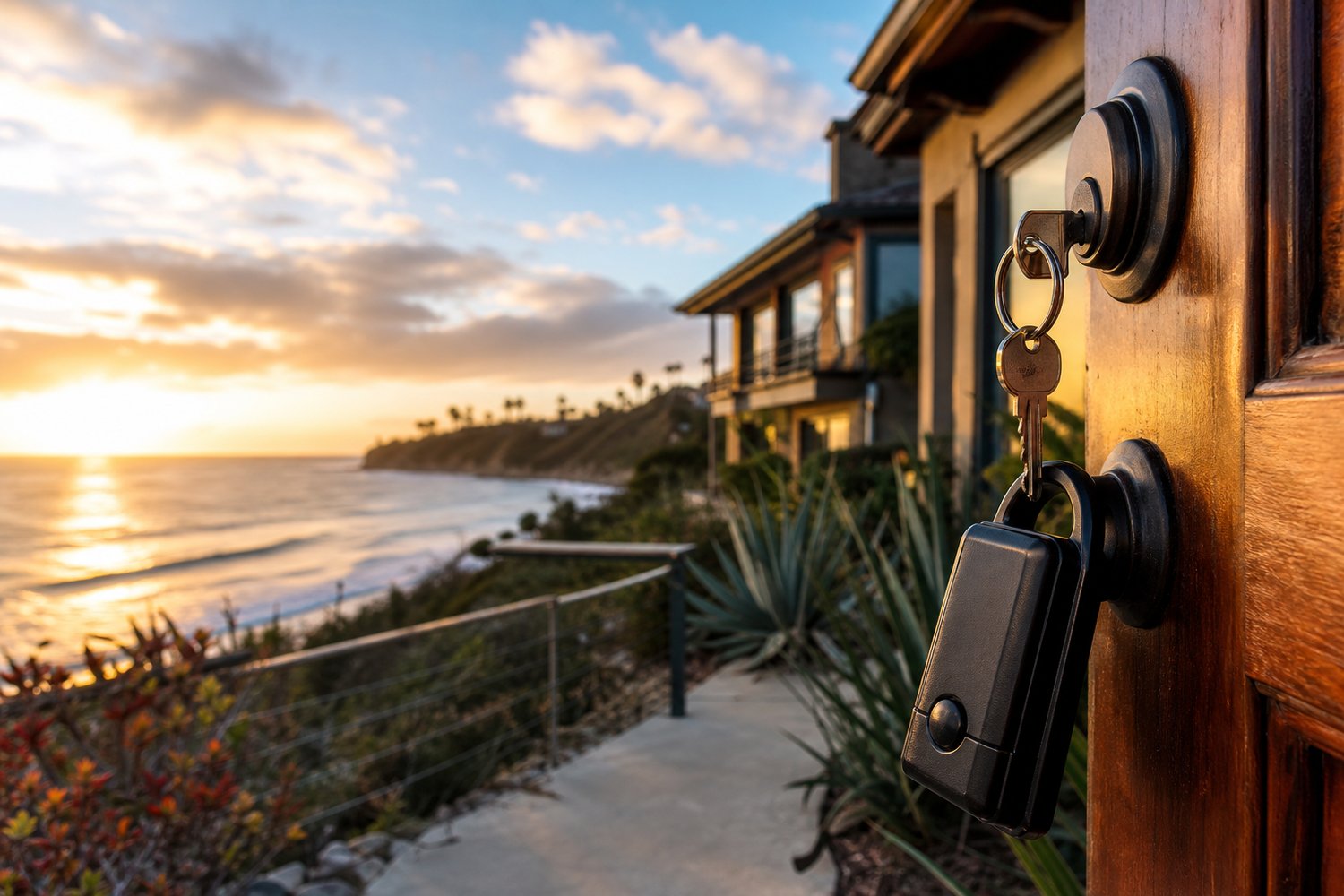
Start with price and paperwork. Match your price to true coastal comparables, pull your permit history, note what salt air and drainage have done to the property, and ask escrow to itemize every closing charge in writing. Settling these before you list keeps surprises out of negotiations.
What should you check before selling a coastal home in Encinitas?
Before you list a coastal home in Encinitas, check five things: how your price compares to true coastal comparables, whether your permit history is clean, how salt air, drainage and shoreline exposure have affected the property, what escrow will itemize at closing, and whether an older home needs extra paperwork. Each one can change your timeline or your negotiating position once offers start coming in.
Key Takeaways
- Single-family homes sold in Encinitas from July through September 2026 had a median sale price of $2,349,064, up 13.5% from $2,070,000 a year earlier, but that is an area-level median and not your home’s value.
- Those same Encinitas sales closed at an average of 98.7% of list price, with 31% selling above list and 57% below, so the starting price matters.
- The median time from listing to going under contract for those sold single-family homes was 17 days, and 31% of listings took a price cut averaging 5.3%.
- Permits and final approvals for additions, decks, pools, retaining walls and any shoreline or bluff work should be verified with the City of Encinitas and, where applicable, the California Coastal Commission before you list.
- Ask your escrow officer to itemize in writing which party is charged for each closing item, because many allocations are negotiable and a transaction-specific estimate beats any general rule of thumb.
Here is the order I walk my clients through before we ever put a sign in the ground or a listing on the MLS. It starts with price because everything else gets measured against it.
How do you price a coastal home in Encinitas from the start?
You price it against comparables matched by ocean proximity, view, lot, condition and permitted living area, not against the city median. The median tells you where the market sits, but your home sits somewhere specific within it.
1. Match your comps to the coast, not the city name
Recent local market data shows single-family homes sold in Encinitas from July through September 2026 at a median of $2,349,064, or $1,083 per square foot. Over the same window, homes newly listed in Encinitas had a median asking price of $2,771,726. Those are different sets of homes, so don’t read the gap as a discount. It does show why an asking price and a sale price are not the same thing.
Here is how Encinitas sits among the North County markets I work in:
| Area | Median Sale Price | Homes Sold |
|---|---|---|
| Encinitas | $2,349,064 | 101 |
| Carlsbad | $1,949,223 | 196 |
| San Marcos | $1,197,023 | 108 |
| Escondido | $884,647 | 199 |
| Fallbrook | $959,617 | 62 |
| Oceanside | $949,621 | 316 |
| Solana Beach | $2,698,924 | 24 |
These are area-level medians. Within Encinitas, pricing can differ materially among Encinitas proper, Cardiff-by-the-Sea and Leucadia. A good coastal comparable matches your home on distance to the ocean, bluff or beach access, view, lot topography, erosion exposure, condition, parking and permitted living area. A home a few blocks inland can be a poor comp even when the city name is the same.
Also ask what each quoted number actually measures. A median sale price, an average sale price, an active-listing price and days on market for closed sales are not interchangeable. The North San Diego County Association of REALTORS® market report lists the North County indicators and is the place to confirm exact metric definitions.
Why the first price does the heavy lifting
On the single-family homes that sold from July through September 2026, 40% went under contract within two weeks of listing, and the median was 17 days from listing to pending. Yet 31% of listings took a price cut averaging 5.3%. In my experience, the price you set on day one does more for you than any reduction later. Buyers see the listing history, and a home that starts high and chases the market down often sells for less than one priced correctly at the outset.
Supply is also a factor. Single-family homes sold in Encinitas over that window had 2.5 months of supply, and the number of homes sold was 101 versus 124 a year earlier. Homes for sale now (all home types) include 111 active listings and 38 new listings in the last 30 days. That is a market where buyers have choices, so a coastal home in Encinitas needs a price that holds up against the competition from the first showing. For a deeper look, see my post on pricing your Encinitas home right and what Encinitas coastal sellers get wrong before listing.
Your specific number depends on your home’s location, condition and timing. That is where a local market analysis comes in.
What permit and condition issues should you check on a coastal home?
Verify that every addition, deck, pool, wall and shoreline improvement has permits and final approvals, then look honestly at how the coastal environment has treated the property. Buyers and their inspectors will do both.
2. Confirm permits and final approvals
Before listing a coastal home in Encinitas, assemble the paperwork for work done over the years:
- Additions and remodels
- Decks, patios and pools
- Retaining walls and drainage work
- Shoreline or bluff-related improvements, including any seawall
- Garage or accessory-space conversions
Whether a particular improvement needed city or coastal approval depends on its location, scope and permit history. Don’t assume the answer from an old listing description. Confirm any unresolved code, building or coastal-development questions with the City of Encinitas Development Services and, where relevant, the California Coastal Commission. If something turns up, you want to learn it before a buyer’s agent does, while you still have time to resolve it or price around it.
3. Look at coastal wear before a buyer does
Coastal properties can involve bluff or shoreline exposure, drainage, and corrosion. Walk the property with those in mind:
- Check drainage around the foundation, patios and any slope or retaining wall.
- Look for corrosion on railings, fasteners, gates, window hardware and exterior mechanical equipment.
- Note the condition of any seawall or other coastal improvement and gather any records you have for it.
- Make obvious repairs, and decide on a credit or price adjustment for the rest.
I can’t tell you what your home needs without seeing it, and a licensed inspector or contractor should confirm anything structural. Walking a property with a seller before we list is something I do routinely, and it usually shapes both the price and the preparation plan.
What should you settle with escrow before you list?
Ask your escrow officer to itemize, in writing, which party is charged for each closing item, and gather any older-home paperwork early. In California, your escrow officer handles the closing, so these answers shape your net proceeds.
4. Ask escrow to itemize every closing cost
For a coastal home in Encinitas, closing costs vary with the sale price, loan payoffs, title requirements, HOA status, negotiated credits and your contract. That is why I don’t hand sellers a percentage or a general dollar range. A transaction-specific estimate is the only reliable number. Ask your escrow officer to identify these categories:
- Escrow charges for handling the transaction
- Title-related charges
- Recording charges
- Prorated property taxes
- HOA document or transfer charges, where an HOA applies
- Payoff and reconveyance charges for existing loans
- Repair or credit concessions you agree to with the buyer
- Documentary transfer tax, imposed under California Revenue and Taxation Code §11911, with the parties able to agree by contract who pays it
Agent compensation is a separate item. Broker fees are fully negotiable and not set by law, and any compensation a seller chooses to offer a buyer’s agent is optional and separately negotiable. Your listing fee is agreed in your listing agreement. I’m glad to discuss it directly with you.
Many of these allocations are negotiable or customary rather than fixed by statute, so confirm each one in your own contract. The San Diego County Recorder/County Clerk publishes official fee and recording information you can check for your closing date.
5. Check older-home paperwork
If your home was built before 1978, federal law generally requires the lead-based-paint disclosure, any available records or reports, the EPA-approved pamphlet, and an opportunity for the buyer to conduct a lead inspection or risk assessment before the contract is final. The U.S. Environmental Protection Agency explains this in its Lead-Based Paint Disclosure Rule materials. It applies to covered pre-1978 housing whether or not the home is coastal, and it is separate from California’s broader transfer-disclosure requirements. Gather the materials early so they don’t slow down contract negotiations.
If you’re also weighing timing and strategy across the county, my post on key considerations for selling in North County San Diego adds useful context.
If you’d like to see how past clients felt about working with me, you can read my reviews on Google and Zillow.
FAQ
What is the best asking price for a coastal home in Encinitas in 2026?
The best asking price is the one supported by comparables matched to your home’s ocean proximity, view, lot, condition and permitted living area. Single-family homes sold in Encinitas from July through September 2026 averaged 98.7% of list price, so a price that ignores those comps tends to cost you in the negotiation. A local market analysis gets you a number specific to your property.
How long are homes taking to sell in Encinitas?
For single-family homes sold in Encinitas from July through September 2026, the median time from listing to going under contract was 17 days, and 40% went under contract within two weeks. Individual homes vary widely based on price, condition and location. The North County association report is a good place to track the broader trend.
Do I need to verify permits for a seawall, deck, addition or other coastal improvement before selling?
Yes, you should verify them, because whether an improvement needed city or coastal approval depends on its location, scope and permit history. Confirm the status with the City of Encinitas Development Services and, where applicable, the California Coastal Commission. Doing this before you list gives you time to resolve issues instead of negotiating them under a contract deadline.
Who pays the property transfer tax in an Encinitas home sale?
It is commonly negotiated, and the parties may agree by contract who pays it. California’s documentary transfer tax is imposed under Revenue and Taxation Code §11911 on the transfer documented by the deed, but the statute doesn’t dictate who bears the cost between buyer and seller. Confirm the allocation in your purchase contract and ask your escrow officer to show it on your closing statement.
What does escrow handle when selling a home in California?
Your escrow officer holds funds and documents, coordinates with title, handles payoffs, recording and prorations, and prepares the closing statement showing who is charged for each item. Ask for that allocation in writing before you list so your net proceeds don’t come as a surprise.
Selling a coastal home in Encinitas rewards sellers who do the homework first: price against real coastal comps, verify permits, deal honestly with coastal wear, and get a written escrow breakdown. I walk my clients through all five before listing so there are no surprises mid-transaction. If you want a clear starting point, request your free home valuation and we’ll talk through your property specifically.
Equal Housing Opportunity. Matthew Sorensen, Broker Associate, regulated by the California Department of Real Estate. This article is general information, not legal, tax, or financial advice; confirm your own numbers with your escrow officer, tax advisor, or lender.
- About Matt Sorensen
- Contact Matt

Matt Sorensen is a Broker Associate with Coldwell Banker Realty and a licensed real estate professional since 2000, serving San Marcos and North County San Diego. He specializes in probate and trust home sales, helping trustees and families navigate pricing, disclosures, timelines, and vendor coordination with clear communication and steady guidance. CA DRE Lic. #01293787